
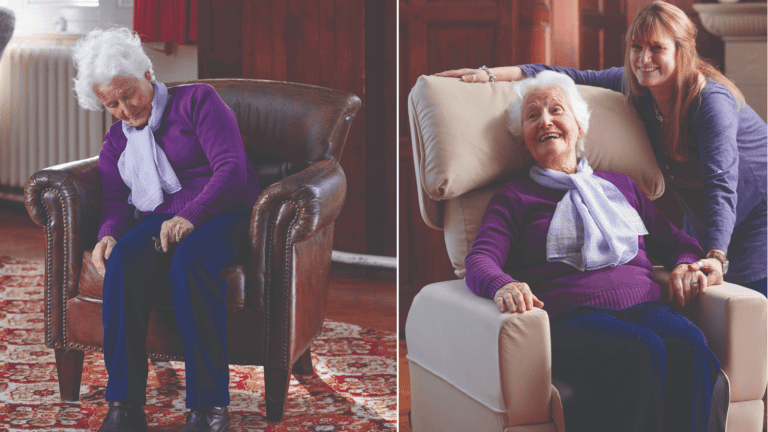
If you or a family member finds sitting harder than it used to be, you may want a comfortable chair that looks good at home and helps you stay safe and steady.
In this article, we provide a clear guide to when a traditional armchair is enough and when a Care Chair is the better choice.
What you will learn:
- How armchairs and Care Chairs differ in everyday use.
- Simple home checks to see what you need.
- What to try with a Seating Assessor before you buy.
The short version
- A traditional armchair is familiar and cosy. It works well if you can keep a steady position and sit upright without additional support.
- A Care Chair is set up for your body shape and size and is tailored to your needs and specific requirements. It supports posture and skin, helps reduce sliding, and can be adjusted as your needs change. It can support a range of medical conditions and mild to complex postural challenges.
When an armchair can be enough
If your posture is steady and you sit for shorter sessions, an armchair can be a good choice. You should be able to:
- Sit upright for at least 30 minutes without sliding or leaning.
- Place both feet flat on the floor.
- Stand up and sit down with control, using the armrests, without the seat feeling too low.
- Stay comfortable without extra cushions for your back or under your thighs.
If these points are met and you like the look and feel, an armchair may serve you well.
Where armchairs can fall short
Many armchairs are deep, low, and too soft; they can look inviting yet cause problems.
Seat depth: If the seat is too deep, the front edge presses behind your knees and pushes your pelvis forward. When you sit right back, you should aim for a small two-finger gap between the cushion front and the back of your knees.
Seat height: If the seat is low, your knees sit higher than your hips and standing up is harder. A seat that is too high leaves your feet dangling.
Back shape: Flat backs do not guide you towards midline or support your spine; you may lean and tire quickly.
Armrests: Arm support that is too low or too wide apart reduces leverage for safe sit-to-stand.
Foams and fabrics: Very soft foams can compress, and shiny fabrics can increase sliding.
If you recognise any of these challenges, consider a different set-up, or a Care Chair.
What a Care Chair does differently
A Care Chair is sized and adjusted to you, tailored to your needs and clinical requirements. The aim is simple: sit safely with less effort and stay comfortable for longer.
- Posture support: Shaped cushions help keep your pelvis and trunk centred, so you feel balanced.
- Tilt-in-space: You can rest by tilting the whole chair back while keeping your alignment, which reduces sliding.
- Feet supported: Footplates are set to your leg length so both feet can rest flat.
- Pressure care: Cushions are chosen to protect skin integrity when you sit for extended periods.
- Adjustable by design: Seat depth, width, height, and supports are set to your measurements and can be changed later.
Five simple checks you can do at home
Sit as you would on a typical day and ask yourself the following:
- Back and pelvis: Can you sit right back against the backrest without slumping or shuffling forward after a minute or two?
- Knees and seat edge: Do you have that small two-finger gap behind your knees, or does the cushion press against your legs?
- Feet: Do both feet rest flat and feel supported?
- Reach: Can you reach a drink or the TV remote without feeling unsteady or falling forward?
- Energy: Do you feel stable and comfortable after five minutes, or are you fidgeting, propping yourself up, or feeling tired?
If one or more answers are “no” a Care Chair assessment will likely help.
How to decide, made simple
- Choose an armchair if you are steady when seated, sit for shorter sessions, and the fit checks above are all positive.
- Choose a Care Chair if you slide, lean, tire quickly trying to sit upright, have any skin risks, or need the chair adjusted to you.
Summary:
The right chair should feel like part of your day, not a daily struggle. Use the simple checks, try before you buy, and involve a Seating Assessor if you need more support. If you get the fit and set-up right, you will sit more comfortably, feel steadier, and have more energy for the things you enjoy.