
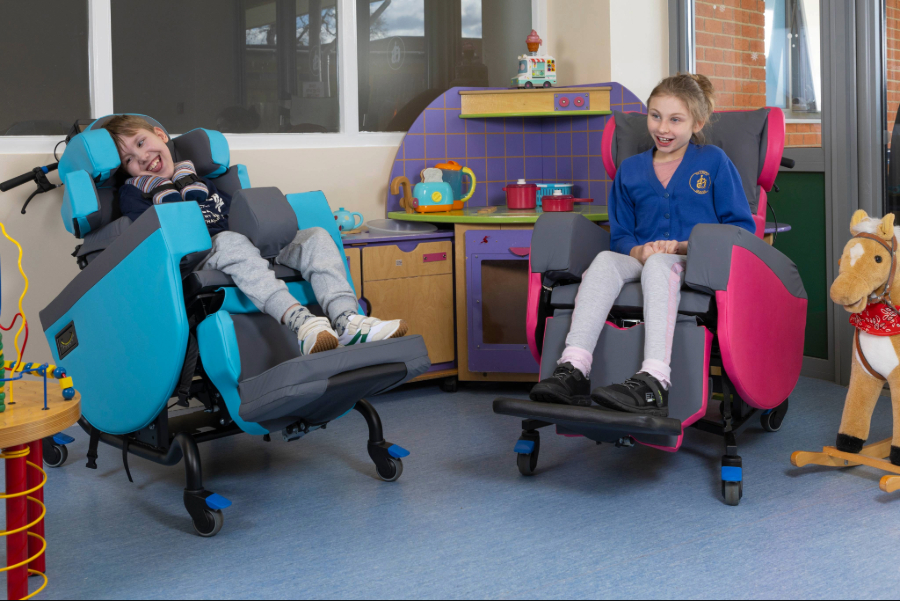
When discussing paediatric seating, conversations often focus on participation, learning, and development. Understandably, clinicians, families and educators want children to access educational opportunities, engage in activities, and interact with the world around them as independently as possible.
These are all hugely important objectives. However, our understanding of participation and development should not begin and end in the classroom.
Children Do Not Stop Being Children When the School Day Ends
A child may spend only part of their day engaged in formal education. The remainder may involve spending time with family and friends, taking part in hobbies, playing games, watching television, using technology, sharing meals or simply relaxing. These experiences are not separate from development. They are an essential part of it.
Many of the skills we aim to support, including communication, social interaction, independence and confidence, are developed through everyday experiences and meaningful participation in daily life. For children with complex physical and postural needs, seating can play an important role in enabling these opportunities.
Participation Is More Than Function
When discussing seating provision, it is natural to focus on function. We want children to communicate effectively, access activities, interact with their environment and participate as fully as possible. However, function alone does not always tell the whole story.
A child may be able to complete an activity successfully yet require significant physical effort to do so. Sitting may demand continual postural adjustment, high levels of concentration or considerable muscular effort simply to maintain a stable position. As the day progresses, fatigue may increase, sitting tolerance may reduce and participation may become more challenging.
This reminds us that successful seating should not be judged solely on whether a task can be completed. Comfort, stability, endurance and sitting tolerance all influence a child’s ability to participate meaningfully throughout the day.
Different Activities Create Different Demands
Children move between a wide variety of activities throughout the day, each placing different demands on the body. At some points, the priority may be learning, communication and active engagement. At others, the focus may be social interaction, leisure, relaxation, and family life.
Different activities may require different levels of support. A seating setup that helps optimise concentration, proximal stability, upper limb function, and access to learning may not necessarily be the same setup that best supports comfort, prolonged sitting tolerance, or relaxation later in the day.
This does not mean one approach is more important than the other. Rather, it highlights the importance of considering the child’s wider daily experiences when thinking about seating provision.
Looking Beyond Positioning Alone
Historically, seating discussions have often focused on posture and positioning. Whilst these remain important considerations, posture is rarely the outcome in itself. Successful seating is about understanding what positioning enables the child to do.
Appropriate support can help improve stability, reduce the effort required to maintain posture and create opportunities for sustained engagement. This may influence communication, interaction, participation, and overall wellbeing. A child who feels physically supported may be better able to engage in activities for longer periods, interact more comfortably with others and participate in the experiences that matter most to them. When viewed through this lens, seating becomes about much more than alignment alone.
Supporting Participation Throughout the Day
For many children, participation extends far beyond structured educational settings. Family life, friendships, hobbies, leisure activities, and everyday routines all contribute to development and quality of life. These experiences deserve the same consideration as classroom-based activities when thinking about seating provision.
As clinicians, it can be helpful to move beyond asking, “what seating does this child need?” and instead consider, “what is this child trying to do, and what support do they need to participate successfully?”
This subtle shift encourages us to think not only about positioning, but also about comfort, endurance, wellbeing, and sustained engagement. Ultimately, effective seating is not simply about supporting learning. It is about supporting children to participate in the activities and experiences that make up their everyday lives.
Because development is more than education, and participation does not stop when the school day ends.